Most independent hotels don't have a dedicated revenue manager. The owner, the general manager, or whoever is free that morning ends up adjusting rates between check-outs, and that usually means pricing gets updated when there's time, not when the market actually moves. Research into revenue management for properties under 100 rooms puts the manual cost at roughly 35 rate updates and up to 10 hours of work a day if you're trying to stay properly competitive. Almost no small property has that kind of time to spare.
The good news: a hotel revenue management system (RMS) doesn't need enterprise pricing or a full-time analyst to run it well in 2026. It does need the right feature set. Here are the eight capabilities that actually matter for small and independent hotels, and what to check for before you commit to a vendor.

1.
Pricing that runs on autopilot, not on your calendar
The single biggest shift for small-hotel revenue management is autonomy. A system that requires someone to log in every morning and approve rates isn't really automation. It's a dashboard with extra steps. Look for a platform that can price rooms in real time, react to a competitor's midday rate drop without waiting for a human to notice, and still let you set the boundaries (minimum/maximum rates, blackout dates) it operates within.
RevControl's AutoPublish, for example, offers manual, automatic, and hybrid modes, so a small property can start with full automation and dial in more manual control only where it actually wants it, not because the system forces a daily check-in.
2.
Native, two-way PMS and channel manager integration
An RMS is only as good as the data flowing in and out of it. If rate changes have to be re-keyed into your property management system (PMS) or channel manager by hand, you've recreated the exact manual workload you bought the software to eliminate, and added a new source of pricing errors on top of it.
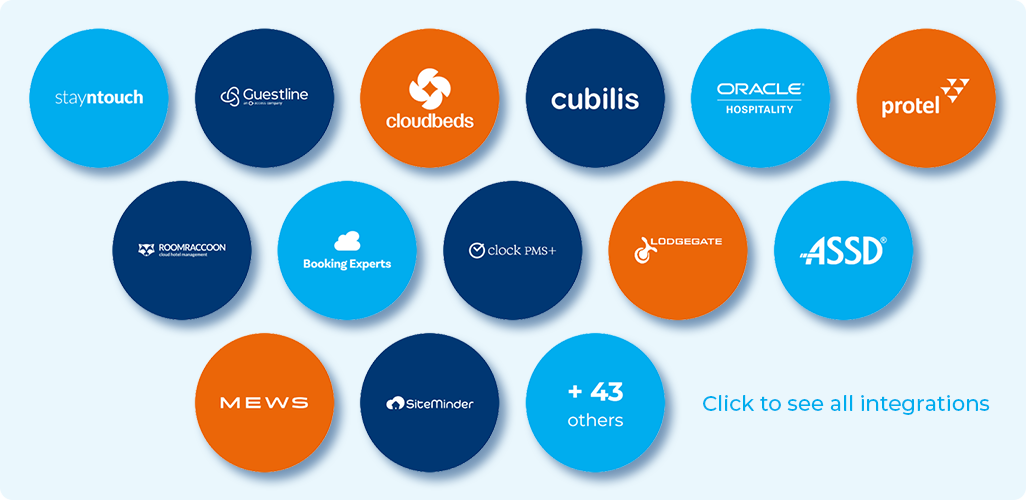
Before signing up, confirm the vendor has a native, two-way connection to your specific PMS, not just a generic export/import. RevControl currently integrates directly with 50+ PMS and channel manager systems, including common choices for independent properties like Mews, Cloudbeds, Guestline, Opera Cloud, RoomRaccoon, Noovy, and Clock.
3.
Recommendations you can actually understand
"Black box" pricing is a real trust problem for small hotels. If a system tells you to drop your rate by 20% overnight with no explanation, most independent owners will simply override it, losing the benefit of automation entirely. The features that matter here are visible reasoning: why is the rate what it is and what data fed into it.
A system that shows its logic (occupancy pace, competitor movement, historical pickup) rather than just outputting a number is what lets a non-specialist operator trust the tool enough to actually leave it running.
4.
A rate calendar that forecasts further than next week
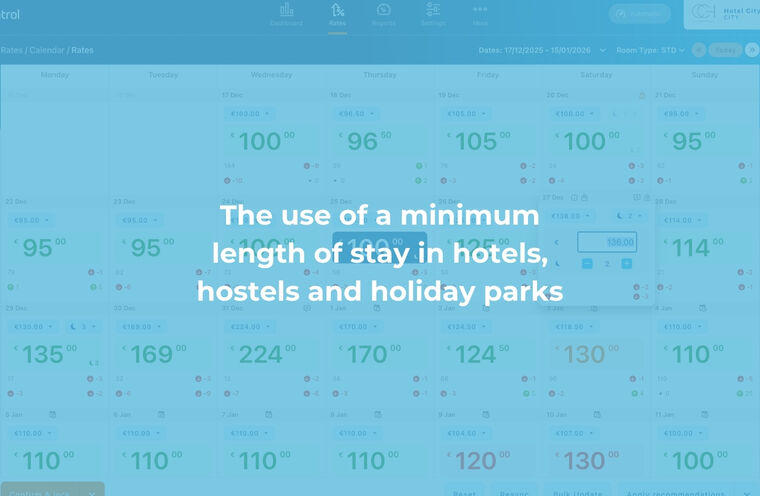
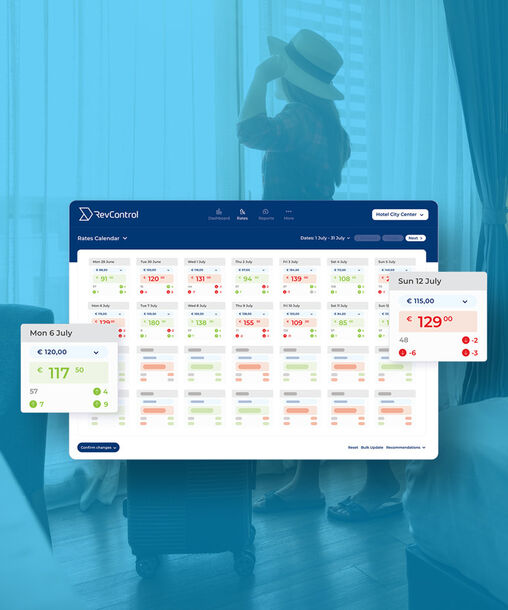
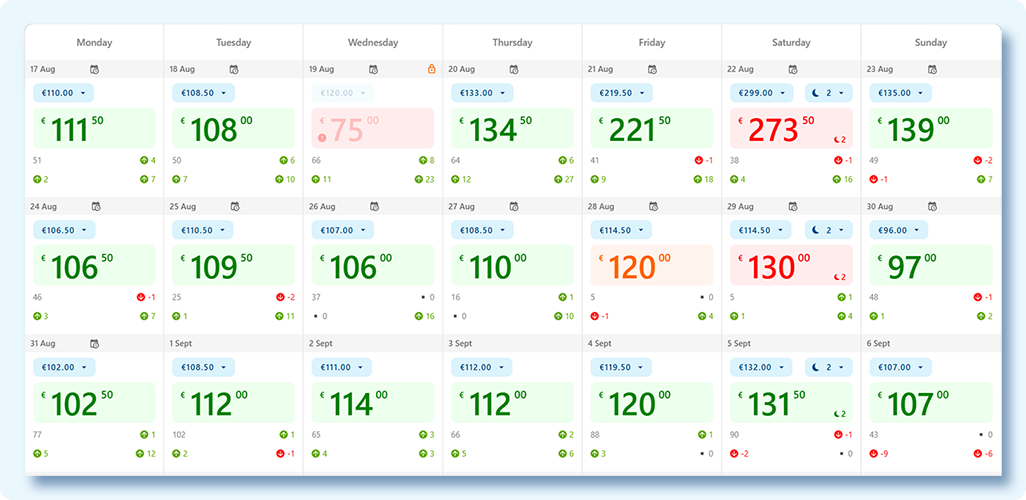
Short-term pricing tools react to what's already happening. A proper RMS should let you see and adjust rates well into the future. RevControl's Rate Calendar, for instance, surfaces recommendations up to 365 days out, refreshed as often as four times an hour as new booking data comes in.
For small hotels, that long horizon matters most around moments when demand suddenly jumps: local festivals, conference calendars, school holidays, or seasonal patterns that a generic algorithm won't catch unless it's tuned to your specific market.
5.
Built-in competitor rate shopping
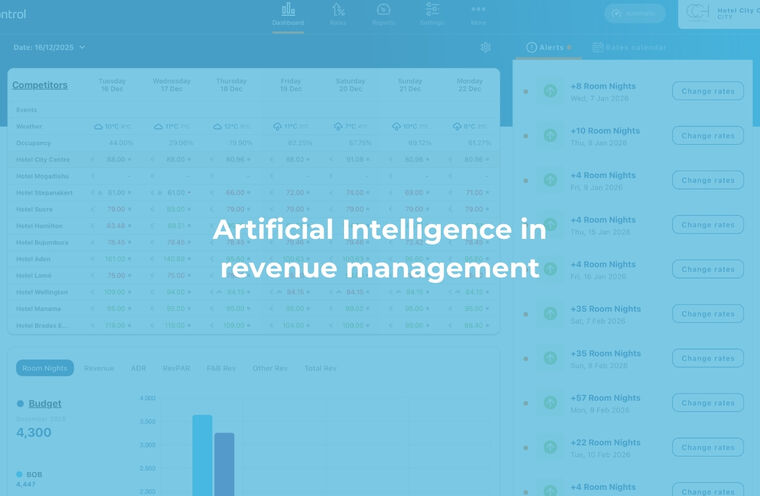
Knowing what your comp set is charging used to require someone manually checking OTAs every day. In 2026, this should be a background feature, not a task. A good RMS tracks competitor rates automatically and flags sudden competitive moves as they happen, feeding that intelligence directly into pricing decisions rather than leaving it as a separate spreadsheet exercise.
6.
Occupancy-based rate rules that adjust themselves
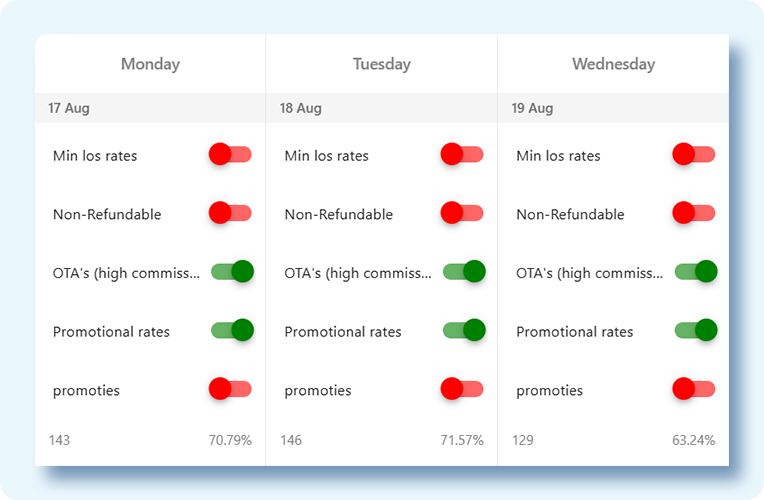
Static rate plans don't respond to how a stay period is actually filling up. Look for a system that can automatically open and close rate tiers based on real-time occupancy or forecasted business-on-the-books, tightening availability on cheaper rate buckets as a date fills without someone having to notice and act manually. This is one of the more overlooked features on vendor checklists, but it's often what separates a system that merely "suggests" rates from one that actively manages inventory and yield.
This is exactly what RevControl's Rate Buckets feature handles: it automatically opens and closes rate groups based on your current business on the books or forecasted occupancy, so the cheaper tiers close themselves off as a date fills without anyone needing to log in and do it by hand.
7.
Dedicated tools for group and block-booking rates
Group and event bookings follow different economics than transient stays, and pricing them by hand (checking availability across a date range, calculating minimum acceptable rates, factoring in displacement) eats disproportionate time for small properties that don't have a sales team to lean on. An RMS built for independent hotels should include a purpose-built group rate calculator, not just a transient pricing engine that group requests get awkwardly forced into.
8.
Business-on-the-books reporting that speaks hotelier, not data scientist
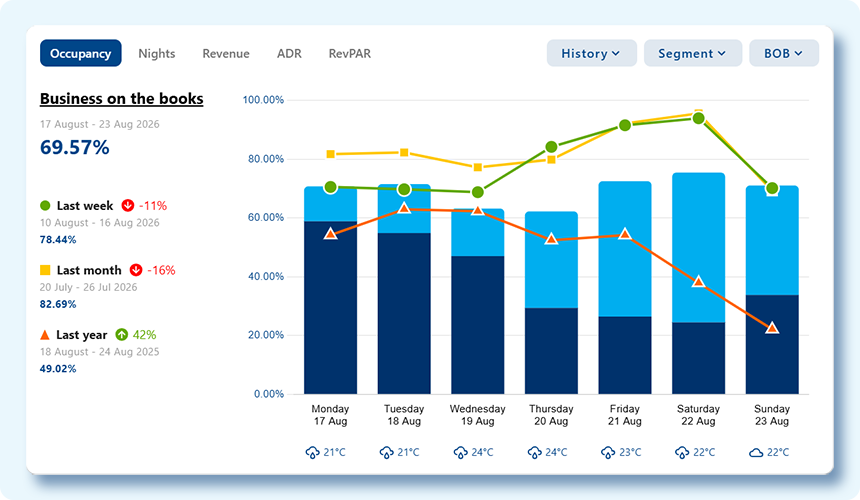
Finally, an RMS needs to show its work in terms that map to how small hotels actually think about performance: business on the books versus the same time last year, occupancy and ADR pace, pickup trends, and forecast accuracy over time, not just a raw dashboard of statistical outputs. For an owner-operator checking numbers between shifts, clarity beats sophistication every time.
Choosing the right fit for a small property
None of these features require an enterprise budget to get right, but not every RMS on the market was actually built with a 20-to-80-room independent hotel in mind. When evaluating vendors, ask specifically how each of these eight areas works for a property your size, not just whether the feature exists on a data sheet.
RevControl was built for exactly this segment: independent hotels, boutique properties, hostels, and small groups, with AutoPublish, Rate Calendar, Competitor Intelligence, Rate Buckets, and a dedicated Group Rate tool covering all eight areas above inside one platform. If you want to see how it handles your specific PMS and market, get in touch for a demo of our system or a quotation.